 ThumbGlance
Clickbait Thumbnails: Curiosity vs. Misleading Promises
A thumbnail can attract attention by raising a question that the video answers. It becomes misleading when it leads viewers to expect something the video does not contain. YouTube's thumbnail policy explicitly covers that mismatch. YouTube thumbnail policy
Three thumbnail promises, checked against video facts
The images below are static examples, not playable videos. They use frames from three locally made demonstrations: a modeled crop, an illustrated desk update and a file comparison. The fact notes describe what happens in each source video. The examples were not uploaded to a video platform or tested with viewers.
A crop tutorial: the missing edges
Source video facts: The local six-second source video models a 1600 × 900 landscape drawing. It marks the centered 900 × 900 region and shows the square result. The sides are removed; no frame restores the entire landscape.
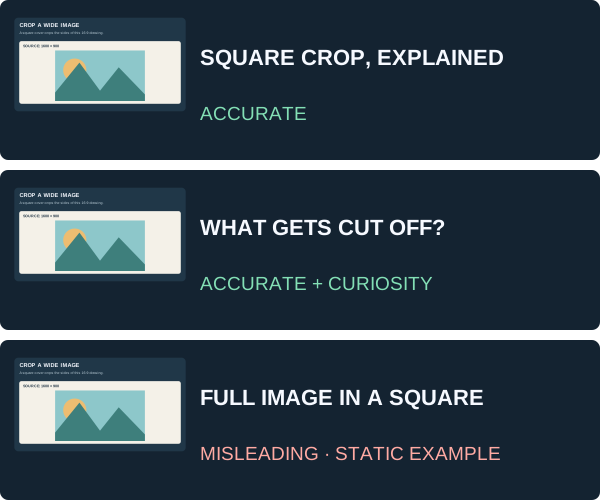
Accurate — “SQUARE CROP, EXPLAINED”: The source video shows the crop region and the resulting square.
Curiosity — “WHAT GETS CUT OFF?”: The question concerns the shaded edges. The source video identifies those edges before showing the result.
Misleading — “FULL IMAGE IN A SQUARE”: A viewer can expect the entire wide image to fit in the square, while the shown method removes both sides. Revise the claim to “SEE THE SQUARE CROP”.
A desk makeover: what the budget covers
Source video facts: The local six-second illustrated source video starts with an existing desk and adds one lamp labelled $20. The source video prices the lamp only; it does not price the desk or assemble a full setup for $20. The prices are example inputs, not a recorded purchase.
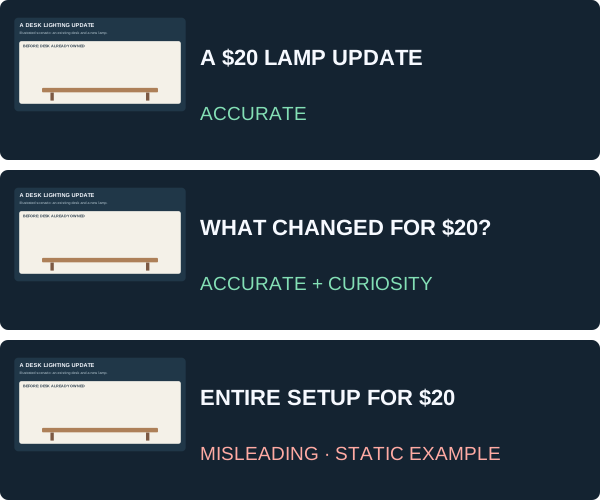
Accurate — “A $20 LAMP UPDATE”: The price refers to the one added lamp, matching the scenario.
Curiosity — “WHAT CHANGED FOR $20?”: The source video answers that the change is a lamp; the question does not promise a whole setup.
Misleading — “ENTIRE SETUP FOR $20”: The claim assigns the lamp price to the desk and all equipment, whose costs are not shown. Revise the claim to “A $20 LAMP UPDATE”.
A file comparison: one result versus a universal claim
Source video facts: The local ten-second source video compares two self-made images saved locally as PNG and JPEG. The illustration is 36,498 bytes as PNG and 28,898 bytes as JPEG. A flat-color image reverses the order: 2,746 bytes as PNG and 6,343 as JPEG. Both JPEGs use ffmpeg q:v 5. These results do not compare visual quality.
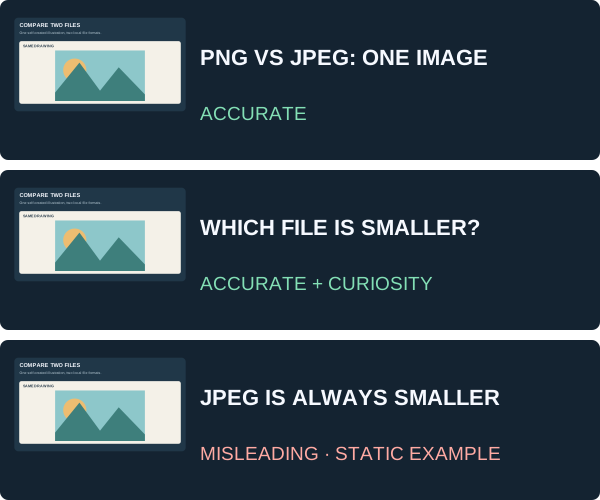
Accurate — “PNG VS JPEG: ONE IMAGE”: The source video compares both file sizes for the same illustration.
Curiosity — “WHICH FILE IS SMALLER?”: The illustration in the thumbnail limits the question to its two files; their displayed byte counts answer it.
Misleading — “JPEG IS ALWAYS SMALLER”: The flat-color image produces a smaller PNG than JPEG, so the universal claim fails for this example. Revise the claim to “JPEG IS SMALLER HERE”.
Check the promise before publishing
Write down what a viewer would expect from the image, text and title together. Locate the matching moment or explanation in the finished video. If it is missing, change the promise or add the promised content. A question can withhold an answer, but the video should answer the question it raises.
Use the thumbnail preview to check readability and cropping after you have checked the promise against the video.
Sources and scope
YouTube’s spam policy also addresses maliciously misleading titles, thumbnails and descriptions that promise content a video does not deliver. These policies cover more than the examples on this page; read the original guidance before publishing.
Sources checked November 8, 2026: YouTube thumbnail policy and YouTube spam policy.